

When developing a new product, one of the main goals is to create a design that works well, meets requirements, and delivers strong return on investment (ROI). The earlier you can test and improve your design, the more you can reduce costs, avoid mistakes, and create a better product.
One of the most effective ways to achieve this is by moving simulation and analysis into the early stages of the design process. By doing this, design engineers and analysis experts can work together from the start, share knowledge, and make better decisions. This approach helps ensure the product meets specifications without adding unnecessary complexity or cost — also known as avoiding overdesign.
Why Early Simulation Matters
In product development, the cost of making changes grows higher the further you go into the process. If you identify a problem late, fixing it might mean reworking prototypes, adjusting manufacturing plans, or even redesigning major parts. On the other hand, finding and solving issues early allows you to make improvements while costs are still low.
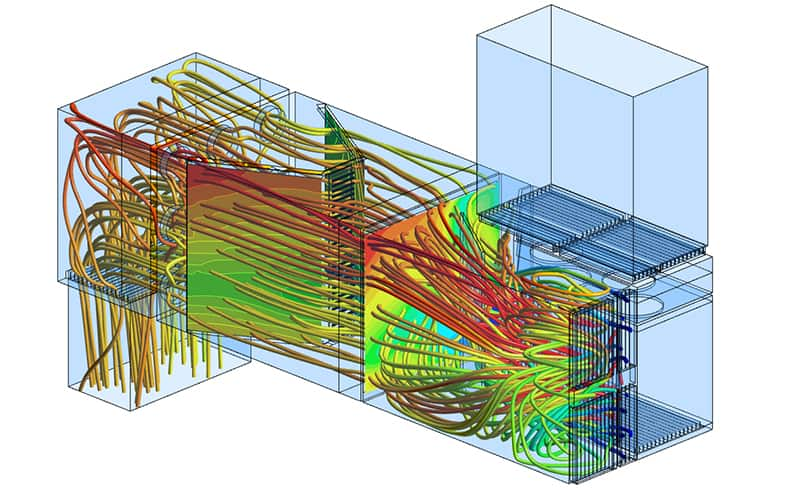
One tool that makes this possible is Computational Fluid Dynamics (CFD) analysis, which helps engineers study fluid flow, heat transfer, and similar factors in a product before it’s built. Whether you’re designing a car part, a cooling system, or an industrial machine, CFD can help you predict performance and avoid costly mistakes.
What Is CFD Analysis?
CFD analysis is a computer-based simulation technique that has been used for decades in engineering. It relies on mathematical methods to solve equations that describe how fluids (like air or water) move and interact with different surfaces.
In simple terms, CFD lets you see how a design will behave under real-world conditions — without having to build a physical model first. This means engineers can test and refine ideas much earlier in the design process, which reduces risk and saves money.
Increasing Productivity with Front-Loading CFD
One of the best ways to get value from CFD is to front-load the simulation process. This means running simulations at the very start of design work, rather than waiting until later stages.
By simulating early:
- You can quickly identify which design ideas are worth developing further.
- You can drop concepts that are unlikely to meet performance goals.
- You can make improvements while changes are still easy and inexpensive.
It’s also important to run simulations regularly as the design evolves. Frequent testing allows engineers to keep up with design changes, explore new possibilities, and fine-tune details without slowing down progress.
Reducing Prototypes and Costs with Virtual Validation
Another way to improve ROI is through virtual validation — the process of testing a digital version of your product using computer-aided design (CAD) and engineering tools.
Instead of building multiple physical prototypes, engineers can create a 3D model and test it under different conditions, such as extreme temperatures, high pressure, or heavy use. This process helps confirm that the product will work as expected before expensive materials or manufacturing processes are involved.
Benefits of virtual validation include:
- Lower costs by reducing the need for multiple prototypes.
- Faster development timelines since testing can happen instantly in software.
- Fewer surprises during manufacturing and product launch.
Key Takeaways
Early simulation and analysis can transform the design process by making it faster, more accurate, and more cost-effective. By using CFD analysis and virtual validation from the beginning, companies can:
- Avoid overdesign and unnecessary costs.
- Improve collaboration between engineers and analysis experts.
- Make informed decisions that lead to better products.
- Increase ROI by reducing time, waste, and errors.
In short, the earlier you start testing and improving your design, the better your chances of creating a high-performing product that meets expectations while staying within budget.