

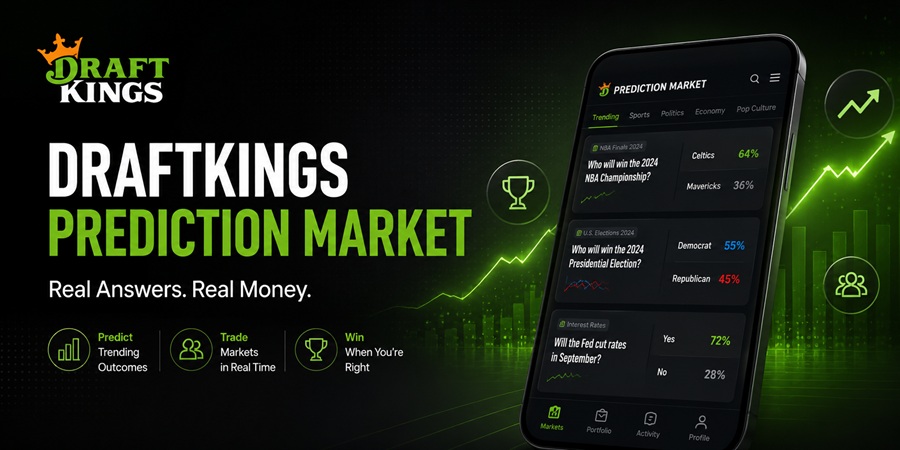
For years, DraftKings built its empire on fantasy sports and traditional sports betting. Millions of Americans knew its name because of March Madness brackets, NFL Sunday lineups, and the thrill of watching a parlay ticket come through in the final seconds of a game. But late 2025 marked a significant turning point for the Boston-based company. With the launch of DraftKings Predictions, the brand stepped into an entirely different arena — one that looks less like a sportsbook and more like a financial exchange. And the implications for both bettors and the broader online gaming industry are substantial.
What Is the DraftKings Prediction Market?
On December 19, 2025, DraftKings officially launched DraftKings Predictions, a standalone mobile app and web platform that allows users to trade on the outcomes of real-world events. At launch, the platform covered sports and finance markets, with entertainment, culture, and politics categories expected to follow as the product expands.
The mechanics are straightforward. Users purchase “Yes” or “No” contracts on whether a specific event will occur. Contract prices range from $0.01 to $0.99, reflecting the collective market sentiment about the likelihood of an outcome. If a prediction is correct, each contract settles at $1.00. If it is wrong, the contract settles at zero. DraftKings charges a flat fee of $0.02 per contract bought or sold, which keeps the cost structure transparent and easy to understand.
What makes this fundamentally different from a traditional sportsbook is that DraftKings is not setting the odds. The crowd does. Prices move based on how buyers and sellers trade against each other, meaning the market collectively decides the probability of any given outcome. It is a model borrowed from financial derivatives markets, not from Las Vegas.
The Regulatory Angle That Changes Everything
Perhaps the most consequential aspect of DraftKings Predictions is not the product itself, but where it sits from a regulatory standpoint. The platform operates under the oversight of the U.S. Commodity Futures Trading Commission, the same federal body that regulates futures and derivatives markets like the Chicago Mercantile Exchange. This matters enormously.
Traditional sports betting is governed by state-level gaming laws, which means DraftKings’ core sportsbook is only available in 26 states. Prediction markets, classified as event contracts under CFTC jurisdiction, fall outside of state gambling regulations entirely. That opens the door to roughly 40 percent of the U.S. population that had been completely off-limits to DraftKings before — residents of major states like California, Florida, Georgia, and Texas.
For a company that had essentially exhausted the easy growth available through state-by-state sports betting legalization, this is a meaningful unlock. The addressable market is not just bigger; it is also newer, less competitive, and arguably more aligned with a younger generation of users who are already comfortable trading on platforms like Robinhood or interacting with crypto-based markets.
How DraftKings Stacks Up Against Kalshi and Polymarket
DraftKings did not invent prediction markets. Kalshi, which became the first CFTC-regulated prediction market exchange back in 2021, built its reputation through political and economic event contracts and has since expanded aggressively into sports. Polymarket, originally a blockchain-based platform, drew global attention during the 2024 U.S. presidential election when its markets became widely cited as real-time gauges of electoral probability, and it later acquired QCEX, a CFTC-regulated exchange, to establish a compliant U.S. presence.
So what makes DraftKings different? The answer lies in distribution. As Britannica Money notes in its profile of Kalshi, major sportsbooks like DraftKings and FanDuel have partnered with CFTC-licensed exchanges to offer prediction market products, positioning them as bridges between the gambling world and the regulated trading world.
Technically, DraftKings functions as an Introducing Broker rather than operating its own exchange. At launch, it routed customer orders through CME Group, one of the world’s largest derivatives exchanges. However, the company acquired Railbird Technologies in October 2025, a federally regulated prediction market operator whose Railbird Exchange subsidiary is expected to be integrated over time, giving DraftKings greater control over its platform infrastructure and economics.
CEO Jason Robins Is Betting the Future on This
The conviction behind DraftKings Predictions is not subtle. In the company’s fourth-quarter 2025 shareholder letter, CEO Jason Robins called it “the most exciting new growth opportunity we have seen since PASPA was struck down in 2018” — a reference to the Supreme Court ruling that opened the floodgates for legal sports betting across America. That is a bold comparison, and Robins clearly means it.
DraftKings posted full-year 2025 revenue of $6.05 billion, its first year achieving a GAAP profit, and fourth-quarter revenue alone came in at roughly $1.99 billion, a 43 percent year-over-year increase. Despite that strong performance, the company’s 2026 revenue guidance of $6.5 billion to $6.9 billion disappointed analysts who had expected closer to $7.3 billion. Much of the gap is explained by the significant capital Robins plans to deploy into building out Predictions as a standalone business.
The company is also launching a proprietary market-making division this year, which would allow it to earn revenue from facilitating trades on its own platform rather than simply routing orders elsewhere. Combined with the Railbird integration, DraftKings is positioning itself to compete head-on with Kalshi not just as a distributor of prediction market access, but as an operator of its own regulated exchange infrastructure.
The Competitive Pressure From Pure-Play Platforms
It would be incomplete to discuss DraftKings Predictions without acknowledging the pressure that prediction markets have placed on the company’s core sportsbook business. DraftKings CEO Jason Robins acknowledged during the company’s Q4 earnings call that Predictions competitors had a slight impact on January sportsbook handle, primarily affecting lower-margin customers. Investors have not been fully reassured, and shares experienced meaningful volatility in early 2026 on concerns about whether pure-play platforms like Kalshi and Polymarket could erode the sportsbook business even as DraftKings tries to grow into prediction markets itself.
The concern is legitimate. Kalshi’s sports-related “combo” markets, which function similarly to parlays, generated over $100 million in trading volume in a single week shortly after launch, and by April 2026 those exotic markets were hitting $412 million in weekly volume. Polymarket is pushing into the same territory. These are real numbers from real competitors, and they reflect genuine consumer demand for a trading-style approach to sports outcomes.
What This Means for the Everyday User
For someone who has never used a prediction market before, DraftKings Predictions offers a relatively accessible entry point. The brand is familiar, the app experience is polished, and the flat fee structure is easy to understand. The platform also includes responsible trading tools such as deposit limits, cooling-off periods, and self-exclusion options, which reflects an awareness that prediction markets occupy legally ambiguous territory when it comes to tax treatment and problem gambling protections.
One practical consideration worth noting is that the tax treatment of prediction market profits is still unsettled under U.S. law. The IRS has not issued specific guidance on whether event contract gains should be treated as capital gains or gambling income, and the difference carries significant financial implications for active traders.
The Bigger Picture
DraftKings Predictions represents something more than a product launch. It is a signal that the line between sports betting, financial trading, and crowd-sourced forecasting is dissolving in real time. The same generation that grew up playing fantasy football is now comfortable trading prediction contracts, participating in crypto markets, and looking at outcome probabilities the way an earlier generation looked at stock tickers.
Whether DraftKings can execute this pivot while defending its core sportsbook business from well-funded competition remains to be seen. But the ambition is clear, the regulatory foundation is in place, and the addressable market is enormous. The next chapter of the DraftKings story is not just about sports anymore.