

Ask ten professionals what business development means and you will likely get ten different answers. Some will say it is sales. Others will call it partnerships or strategy. A few might describe it as networking with a fancier job title. The truth is that business development is all of those things and none of them entirely. It sits in its own unique space within an organization, touching nearly every function while remaining distinctly its own discipline.
So what exactly is business development, and why does it matter so much for businesses that want to grow sustainably?
The Core Definition
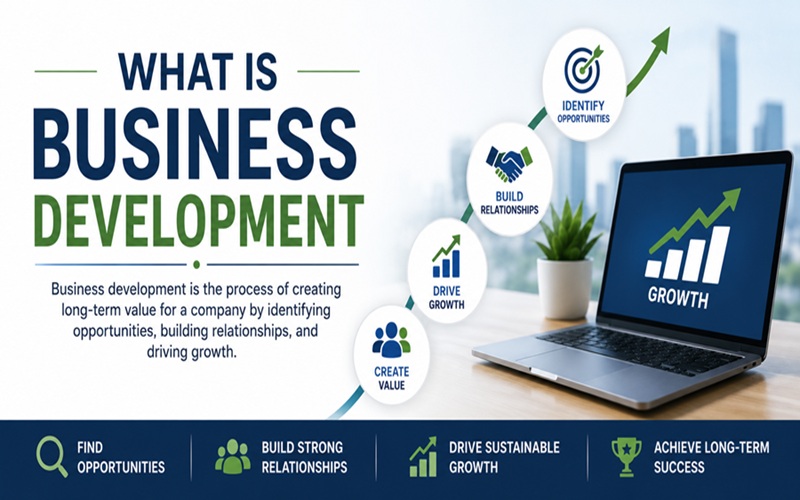
At its most fundamental level, business development is the process of identifying opportunities that create long term value for an organization. Those opportunities might come in the form of new markets, new partnerships, new products, or new customer segments. The goal is always the same: to expand the reach, revenue, and relevance of the business.
Unlike sales, which focuses on converting existing leads into paying customers, business development is concerned with building the conditions that make growth possible in the first place. It is more strategic and often operates on a longer timeline. A business development professional might spend months cultivating a partnership that eventually opens an entirely new revenue channel.
Think of it this way. Sales fills the pipeline. Business development builds the pipeline itself.
What Business Development Actually Looks Like in Practice
The day to day work of business development varies enormously depending on the size and industry of the company. In a startup, one person might handle everything from identifying potential partners to negotiating contracts and tracking market trends. In a large corporation, entire teams are dedicated to specific aspects of the function.
Some of the most common activities associated with business development include market research and competitive analysis, identifying and approaching potential partners or distributors, developing proposals and pitching to prospects, managing relationships with key stakeholders, exploring mergers or acquisition opportunities, and evaluating new geographic or demographic markets.
What ties all of these activities together is a focus on growth through relationship building and strategic thinking rather than transactional selling.
Business Development vs Sales vs Marketing
One of the most common points of confusion in any organization is understanding how business development differs from sales and marketing. The three functions are closely related and often overlap, but each plays a distinct role.
Marketing is responsible for building awareness and generating interest. It communicates the value of what a company offers to a broad audience and nurtures potential customers through various channels.
Sales takes those interested prospects and converts them into customers. It is focused on closing deals and generating immediate revenue. Sales teams work with people who are already aware of the product or service and are evaluating whether to buy.
Business development operates at a higher level of abstraction. It is less concerned with individual transactions and more focused on building the strategic infrastructure that enables both marketing and sales to do their jobs more effectively. This might mean securing a distribution partnership that puts the product in front of a completely new audience, or negotiating a licensing agreement that unlocks a new revenue stream.
In many organizations, business development professionals work closely with both sales and marketing teams, acting as a bridge between strategy and execution.
The Skills That Make a Great Business Development Professional
Because business development requires operating at the intersection of strategy, relationships, and opportunity, the skill set required is genuinely broad. The most effective business development professionals tend to share a number of qualities.
Strong communication is non negotiable. Whether it is writing a compelling proposal, presenting an idea to senior leadership, or negotiating the terms of a partnership, the ability to articulate ideas clearly and persuasively is essential.
Equally important is curiosity. Business development requires a genuine interest in markets, industries, and how businesses work. Professionals who thrive in this role tend to be voracious readers of industry news, always looking for patterns and possibilities that others might miss.
Relationship intelligence is another critical quality. This is not simply about being likable or sociable. It means understanding what motivates different people and organizations, knowing when to push and when to listen, and building trust over time rather than seeking quick wins.
Finally, analytical thinking is increasingly important. Modern business development relies heavily on data to identify market opportunities, evaluate potential partners, and measure the performance of initiatives.
Why Business Development Matters for Every Stage of Growth
Many founders and executives associate business development primarily with large companies or later stage businesses. In reality, it is just as critical for early stage companies and small businesses, though it looks somewhat different at each stage.
For startups, business development is often about finding the right partners and channels to accelerate growth before the company has the resources to scale organically. A single well structured partnership can give a startup access to thousands of potential customers it would otherwise take years to reach.
For growing businesses, business development becomes about diversification and resilience. Companies that rely on a single customer segment or revenue stream are vulnerable. Business development helps identify and cultivate new sources of revenue that reduce that dependency.
For mature enterprises, business development often focuses on innovation and expansion, whether that means entering new geographic markets, acquiring complementary businesses, or developing new product lines.
Building a Business Development Function That Actually Works
One of the most common mistakes companies make is treating business development as an afterthought. They hire someone with the title and expect results without providing the resources, access, or strategic clarity needed to succeed.
Effective business development requires alignment with the overall business strategy. The people doing this work need to understand where the company wants to go and have the authority to pursue opportunities that support that direction. They also need patience from leadership, because the most valuable deals and partnerships often take considerable time to develop.
Clear metrics also matter. While business development is not as easily measured as sales, it is still important to track progress through indicators such as the number of partnerships initiated, the revenue generated through new channels, and the new markets entered over a given period.
The Bottom Line
Business development is one of those functions that is easy to underestimate until you see what a difference it makes. It is the discipline that helps companies look beyond their current customers and channels to find the opportunities that will define the next chapter of their growth. Whether you are running a small business or leading a team at a large organization, investing in genuine business development capability is one of the smartest moves you can make.
Growth rarely happens by accident. Business development is the work that makes it happen by design.