

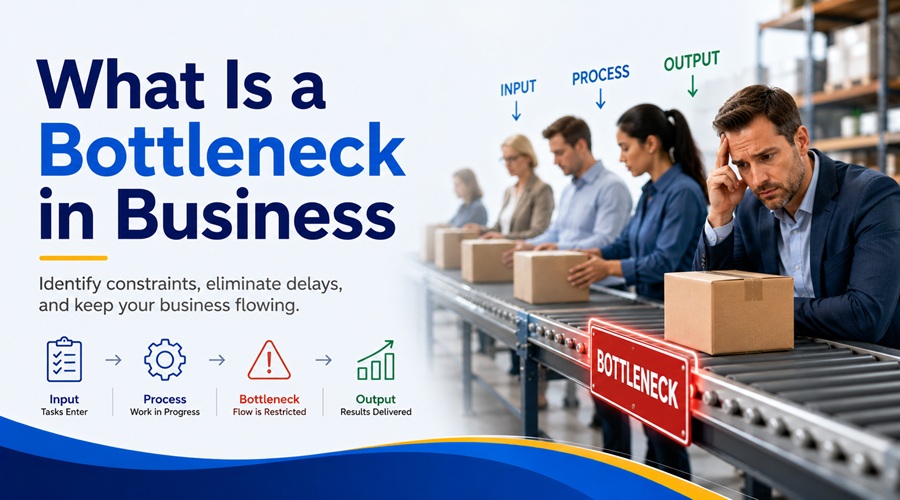
Every business has a pace. And almost every business has at least one point where that pace quietly gets strangled. Work piles up. Deadlines stretch. Customers wait longer than they should. The team works harder but output barely moves. If any of that sounds familiar, there is a good chance your business has a bottleneck that nobody has properly identified yet.
A bottleneck in business is not a vague operational problem or a morale issue or a management failure. It is something specific and locatable: a single point in a workflow or process where the volume of work exceeds the capacity available to handle it, causing everything downstream to slow down or stop. Once you understand what a bottleneck actually is, where to look for it, and how the most effective frameworks address it, you gain a level of operational clarity that changes how you diagnose and fix problems for good.
The Origin of the Term and Why It Fits So Well
The metaphor comes directly from the physical shape of a bottle. No matter how wide the body of the bottle is, liquid can only flow out as fast as the neck allows. Everything above the neck can be full to the brim, but the output rate is controlled entirely by that narrow point at the top. In a business process, any step that cannot keep pace with the work coming into it functions exactly like that narrow neck. It does not matter how efficiently every other part of the process operates. The output of the entire system is capped at whatever the bottleneck can handle.
Picture a fulfillment operation where receiving, sorting, and packing can each handle 200 orders per hour, but the shipping station can only process 80. Every hour, 120 orders pile up at the shipping station. Adding people to receiving or packing does nothing to solve the problem. It just creates a larger backlog faster. The shipping station is the bottleneck, and until its capacity is addressed, the ceiling on total output does not move.
Short-Term vs Long-Term Bottlenecks
Not all bottlenecks are created equal, and understanding the difference between temporary and systemic ones shapes how you should respond to them.
A short-term bottleneck is typically a circumstantial disruption with a clear expiration date. A key employee takes emergency leave and their replacement starts in two weeks. A piece of equipment goes offline for scheduled maintenance. A supplier delays a shipment by a few days, stalling production temporarily. These situations slow things down and require management attention, but they resolve on their own as circumstances return to normal. Overreacting with structural changes to a short-term bottleneck is a mistake that can create new problems while solving a problem that was already going to disappear.
A long-term bottleneck is a different category entirely. It is a systemic constraint that recurs consistently because the capacity of a given step has fallen permanently behind the demand placed on it. Outdated equipment that cannot match production requirements. An approval workflow that requires a single senior person who is consistently overwhelmed. A manual data entry step that cannot scale with transaction volume. Software that crashes regularly under load. These do not self-resolve. They require deliberate analysis, investment, and redesign. Ignoring a long-term bottleneck does not make it smaller. It makes everything around it larger until the constraint becomes critical.
The Theory of Constraints: The Framework Built Around This Problem
The most rigorous and widely adopted framework for understanding and addressing bottlenecks in business is the Theory of Constraints, developed by Dr. Eliyahu Goldratt and introduced to the world through his 1984 business novel The Goal. Goldratt’s central insight was that the performance of any system is determined not by its average capacity but by its weakest constraint. No matter how efficiently the rest of the system operates, the constraint sets the ceiling on overall throughput.
As MindTools explains in its overview of the Theory of Constraints, Goldratt formalized this insight into a repeating five-step process known as the Five Focusing Steps: identify the constraint, decide how to exploit it by getting maximum output from it within existing resources, subordinate everything else in the system to support the constraint, elevate the constraint by expanding its capacity if exploitation alone is not enough, and then return to the first step because once one constraint is resolved, a new one will emerge elsewhere. The process is explicitly cyclical because improvement is not a one-time project. It is an ongoing discipline.
This framework matters beyond the manufacturing context where it was originally developed. Goldratt’s methodology has since been applied successfully across healthcare, software development, retail, banking, logistics, and project management. The underlying logic is universal: every system has a constraint, and improving anything other than the constraint is an illusion of progress.
Where Bottlenecks Actually Hide in Real Businesses
In manufacturing and physical production environments, bottlenecks tend to be relatively visible because they show up as physical accumulations of work in progress. A pile of unprocessed inventory or a queue of waiting units is a visible signal that capacity is being exceeded at that step.
In service businesses, professional services firms, and knowledge work environments, bottlenecks are less visible but equally real and equally costly. They tend to show up as approval delays, long decision queues, and work sitting in someone’s inbox for days. Some of the most common locations for hidden bottlenecks in modern businesses include:
Approval and sign-off processes are a frequent culprit. When a workflow requires authorization from a specific individual or committee that does not have adequate bandwidth to review and respond promptly, work stacks up waiting for that single point of human attention. The bottleneck is not a machine or a system. It is a decision point with insufficient capacity.
Manual data entry and handoff steps create bottlenecks because human throughput is inherently limited and error-prone. When information must be manually copied from one system to another, or when files must be manually processed before they can move to the next stage, the pace of the entire workflow is constrained by how fast a person can do a repetitive task accurately.
Onboarding and quality review processes frequently become bottlenecks in growing businesses because they were designed for a smaller volume of work and have not been rebuilt to match increased throughput. A quality check that worked perfectly when a team handled 50 transactions per day becomes a serious constraint when volume triples.
Single points of expertise create capacity constraints whenever a specific person is the only one who knows how to perform a critical task. When that person is unavailable, on vacation, or simply overwhelmed, the entire process waits.
How to Identify the Bottleneck in Your Own Business
The starting point for finding a bottleneck is observation and data rather than intuition. Work tends to accumulate visibly upstream of the bottleneck, and that accumulation is your most reliable signal. Look for where queues form, where response times stretch, where work sits waiting before it moves forward, and where the same complaints surface repeatedly from customers or team members.
Process mapping is one of the most effective tools for bottleneck identification. By documenting every step in a workflow and the time each step typically takes, you can surface the steps where cycle time is disproportionately long relative to the rest of the process. Process mining tools, which analyze system event data to reconstruct how work actually flows rather than how it was designed to flow, add an additional layer of objectivity by showing actual patterns rather than assumed ones.
Talking to the people who do the work is equally important and often underused. The team members closest to a given step almost always know where the constraint is. They have been working around it, absorbing its effects, and quietly compensating for it in ways that never appear in any report. A direct, non-judgmental conversation about where the process regularly gets stuck will typically surface the bottleneck faster than any analytical tool on its own.
Fixing the Bottleneck: What Actually Works
Once the bottleneck is identified, the first instinct in many organizations is to add resources. Hire more people, buy more equipment, implement new software. This is sometimes the right answer, but it is rarely the first move worth making.
Before adding capacity, organizations should first ask whether the existing capacity at the bottleneck step is being used as effectively as possible. Unplanned downtime, inefficient scheduling, tasks being handled at the bottleneck that could be moved to a less constrained step, and unnecessary waiting time within the bottleneck process itself are all sources of recoverable capacity that cost nothing to unlock. Goldratt called this exploitation of the constraint, and it regularly reveals significant untapped throughput before any capital investment is required.
Subordinating the rest of the process to the constraint is the next step, and it is counterintuitive for many managers. It means deliberately slowing upstream steps if necessary so that the bottleneck always has the optimal input it needs to run at full capacity, rather than being fed more than it can process and generating a backlog. Running a non-bottleneck step at full speed when the bottleneck cannot absorb the output is not efficiency. It is just organized waste.
Only after exploitation and subordination have been exhausted does elevating the constraint through additional investment make clear operational sense.
The Cost of Letting Bottlenecks Go Unaddressed
Unresolved bottlenecks do not stay stable. They compound. A constraint that limits throughput by 15 percent today will create 15 percent less revenue, 15 percent more team frustration, and 15 percent more customer dissatisfaction for as long as it remains unaddressed. As businesses grow and demand increases, the same constraint becomes proportionally more damaging because more work is now being held up at the same narrow point.
The businesses that build sustained competitive advantage are almost always those that have built a systematic habit of identifying and eliminating their constraints rather than working around them indefinitely. A bottleneck is not a sign that something is broken beyond repair. It is a signal about exactly where to focus. And in operations management, knowing precisely where to focus is one of the most valuable things you can have.